
"I create works that ask more than they give"
My 23 years of military service shaped me as an artist and as a human being. But it's not everything that I am. All my experiences fuse into a perspective on the world. That's been shaped by my experiences, my relationships, my love, by where I've been in the world, who I've seen, who I've spoken to, the thousands of conversations that have shaped me. Each artwork that I create is shaped by the conversations that lead into it.
The conversations I have while creating my artworks bring me immense joy. Working with people and teasing out their stories through a natural conversation is something that I really love. The artworks become, like my children. These things that I birth through this process, this alchemy, that occurs. And sometimes it's an alchemy, that's sort of this blend of me and the subject, and sometimes it's a blend of me and the materials. There's an interaction that happens there.
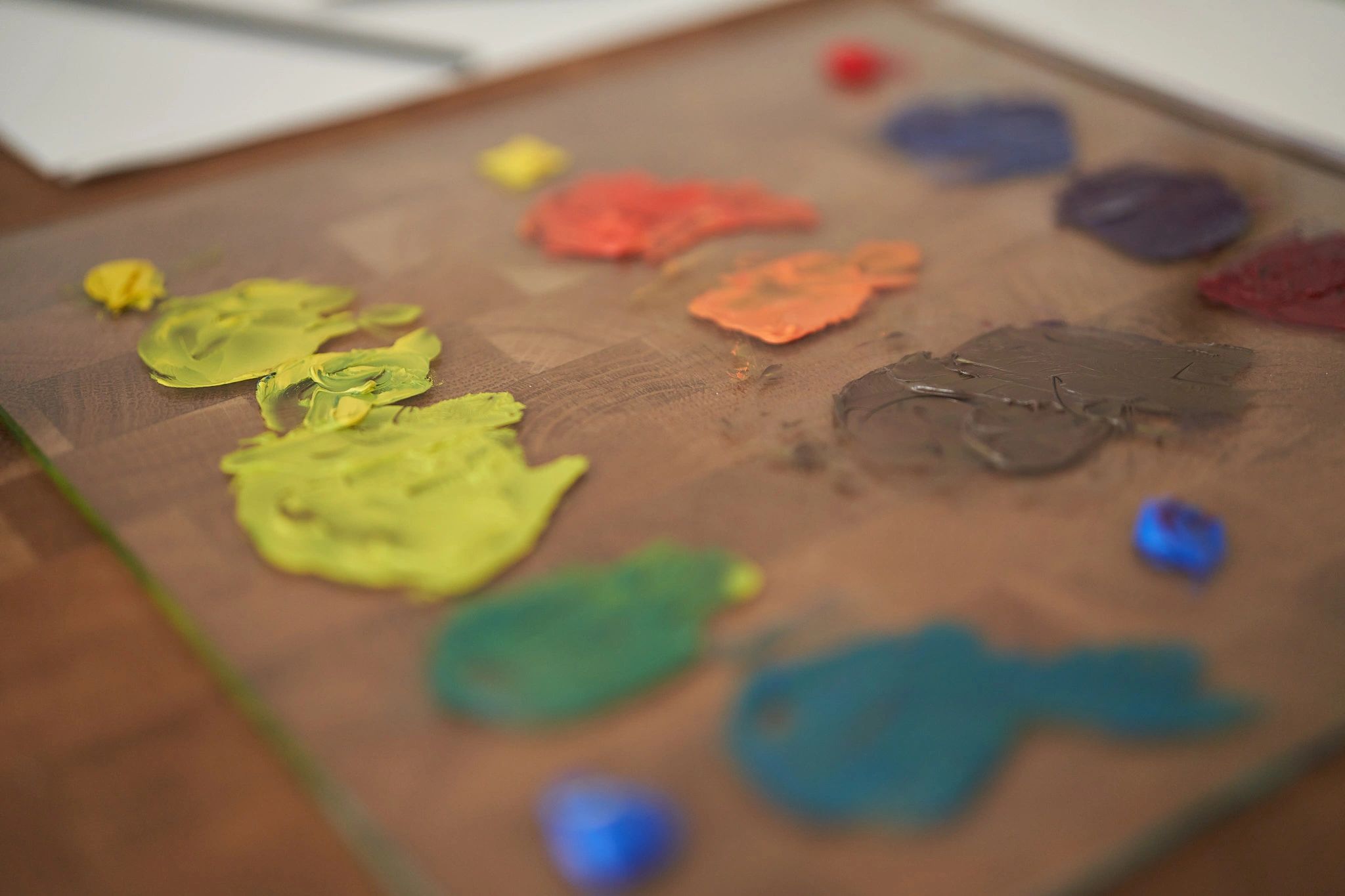
"A blob of paint on a piece of paper can be beautiful in a way that's really hard to explain. I love the idea of it"
When I was younger, I wanted to make things that I thought were beautiful, but also challenging. I remember seeing these huge paintings in galleries and thinking wow, these are just the most fabulous huge things. I wanted to paint big. To create fabulous historical paintings or narratives about mythology. I found artists like Norman Lindsay, who's just passionate about the form and passionate about passion. He revelled in sensuality and sexuality, and something about that, I was like, oh man! He really pushed the boundaries of my upbringing, that's for sure. But I was drawn to the boldness of it. And then there was Brett Whitley, with more sensuality and sexuality, but… the lines! He made these marks, and I remember looking at them, and it was the first time I really recognised it. Beauty.
"There are things that are beautiful, and there are things that are banal. I gravitate towards the beautiful"
As a young boy standing in front of those huge paintings, I don't know if I thought it was possible to make art. I just had my little sketchbooks that my mum bought for me and my pencils. And I made drawings and sketches. I didn't know what else to do because there was nothing else that made me happy, like making art did. It just made sense to me. I remember thinking, "Why would I do something else? This is what I'm good at! And this is what I love to do." And so all through school, that's what I did.
I started painting probably around age 16 after seeing an exhibition by Jillian Russell, who painted animals. I thought they were the most beautiful paintings. They inspired me to paint, and there are a bunch of my little animal paintings in my mum's house still from this time. I think the first one I did was of a dingo's head. I loved the covers of the Australian Geographic Magazine at the time because each cover was a painting. They didn't have a photograph on the cover in those days. There was something about the observation required to create these works that was highly realistic and beautiful. A technical challenge was thrown out to me in those works. I find a lot of fun in being technical, as it gives me a sense of freedom.
"My painting style is a wrestling match"
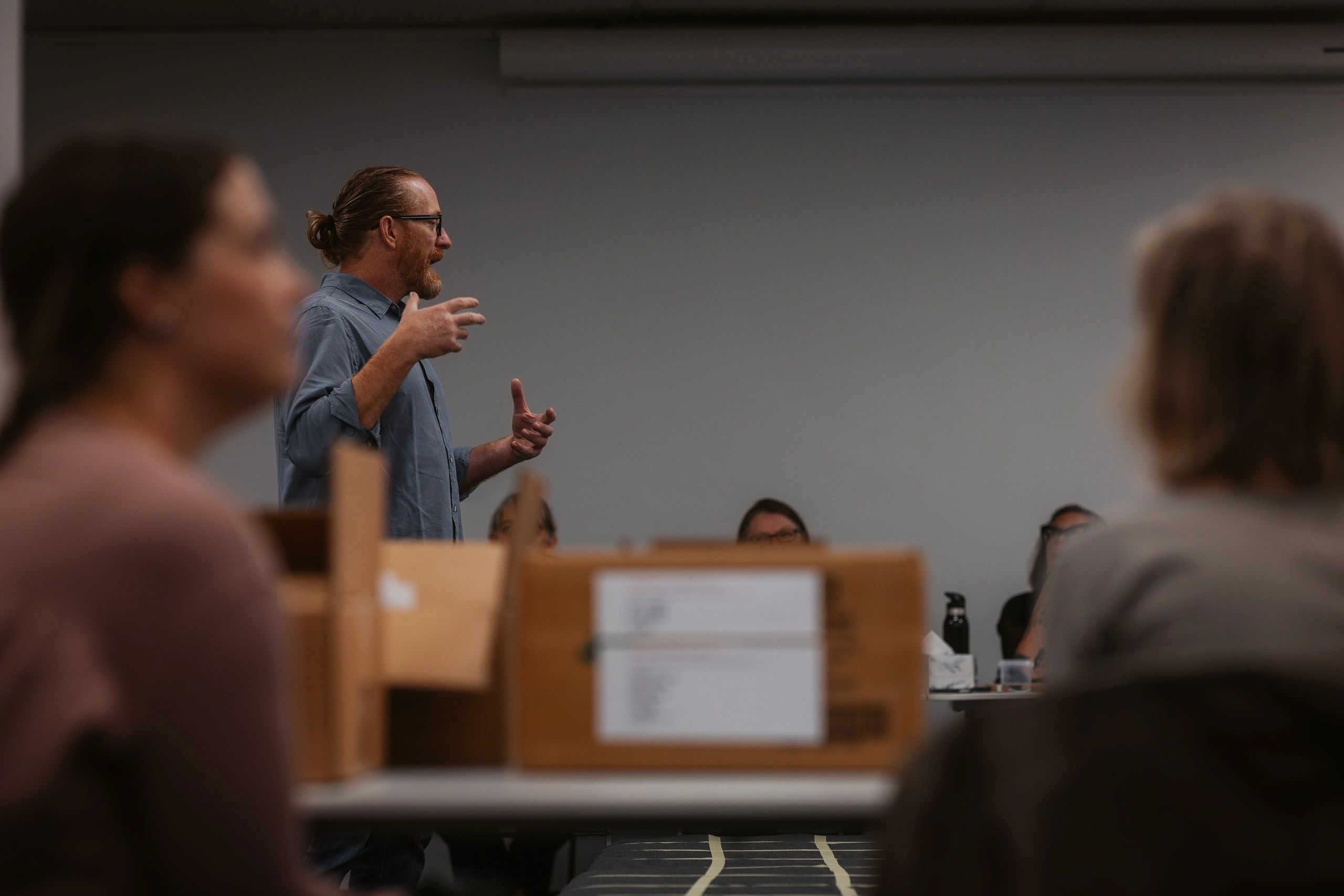
I’d say I have a traditional technical approach: I formulate through an underpainting, I wrestle with design elements in that underpainting phase, and then move through to sort of bring that to life in later layers, like glazing. But some days, it’s different. Some days I paint wet-on-wet, and some days I'll paint in a single layer. Sometimes I'll approach it like a watercolour painting. And even though I'm working in oils, I'll play around and really kill the binders with solvents or other mediums to thin them out like thin washes of oil colour. I'm really interested in different approaches that artists have taken to applying paint and working with it. But I'm also very open to breaking those rules. And so that's why every now and then you'll see a work of mine, and you may think, "That doesn't make any sense".
Quite often, in the process of the freedom that you get when you're doing an underpainting, things come out. Marks are made, and it’s then that there's like a conflict in me, like a wrestling match where I'm sort of looking at these very quick, vibrant, gestural marks that I'm making that are almost impulsive. And then the tightening that can occur with a much more considered approach. And I'm trying to wrestle with how to balance that. It's the same sort of wrestling match that the impressionists had, like Suzanne and Matisse. It's in these ideas that the underpainting is sometimes more powerful than the polished element.
My painting style is a wrestling match. I'm trying to balance the tensions of trying to bring out elements of marks that can be seen, that elicit some sort of aesthetic response, with a subject matter that I'm also trying to be true to and trying to capture some sort of energy from that. So it's not purely an abstract idea. There is a representation in which I'm interacting with the world through my art.

Mike Armstrong teaches art 1:1 and in small groups from his art and wellbeing studio
I started sculpting back at the back end of my master's. I'd pretty well finished all the artworks that I had wanted to complete for my second Master's show. And I had this nagging idea for an artwork, which turned out to be the Monolith series. I had this nagging idea for an artwork, and I was like, well, I've got to sculpt the human form.
There is something about sculpting the human form that really interests me. I've seen works in exhibitions, and I’ve been to Rome, and seen Benini's sculptures, including the Ecstasy of Saint Teresa, which is just a fabulous work. And I witnessed Michelangelo's David in Florence, and I recall standing there just awestruck. These works really hit me in a way I hadn't been hit by an artwork in a long while. There was something about the 3D form that really resonated with me. So I started working with water-based clay and earthen clays. I just bought a block of clay, took some photographs of a model, a friend of mine, and I said, "Can I sculpt that?" It was just an exercise. From this, I created Natal (2015), which became my first bronze.
I was fortunate to meet Layla Bell, a wonderful human being and quite an experienced figurative artist. Layla supported me immensely with my sculpting. She also introduced me to Brian Booth Craig, an American artist and figurative sculptor who has been a huge help and influence. His honesty, his information and friendship have been instrumental in my life.
"My work is living. It is breathing in and breathing out"

My experience in creating nude figures is quite organic. More than any pose, I really fell in love with standing figures. The technical challenge of armature and proportion enables the sort of figurative work that I wanted to make.
A lot of experimentation happens in my studio, and I'm quite good at figuring things out analytically. That's sort of the way my brain works. Give me a problem - I'll engineer slowly through it…Sometimes the sculptures are the problem. Like, how do I represent weight as it falls? How do you get that to look realistic? I think sculpture has strong similarities to dance and performance arts because it uses the body in a performative way. I’m capturing a moment. I ask myself, how do I portray energy beyond this?
"I love how surprised I am by the work I create. I try not to be overly formulaic. I enter flow states and be with the work"
My art comes from a subconscious place. I'm observing each brush stroke and each mark I make in the material. I respond, and I find joy in that - they're like little moments of delight.
At the end of the work, the conglomeration of all these things is there. I look at it, and it's almost like I don't recognise myself in it anymore. It's this other thing. And that's when I'm most happy with the work. When it's hard to recognise as me, when it's this other thing. It becomes an entity in itself, and it sort of leaves the world.
My art is living. It is breathing in and breathing out.
My art becomes like this conglomeration of 10,000 moments and 10,000 points of observation. And sometimes a slump occurs. And it is wonderful. That ends up in my work, and sometimes it's the poise or the strength, and that ends up in there. And so my work is a mix of all those things all at once.
There's an energy that comes through me, and that’s how I breathe life into an artwork. When I work with models, often just friends, not professional models, come into my studio, we talk as I make. I have these wonderful conversations with them, and there's a breathing in, and there's a breathing out, and there's a relaxing into it. I’ve discovered that things emerge because the performance element drops away. The masks fade, and humanity begins to come forward. And I'm not consciously seeing it, I'm not looking for the oh, I see you, gotcha moment. It just sort of drifts into the work as I observe it.
© MICHAEL ARMSTRONG